Have you ever wondered how a simple pill can cure an infection, or how a vaccine can stop a global pandemic in its tracks? The answer lies within one of the most complex, highly regulated, and essential sectors in the world: the pharmaceutical industry.
Whether you are a student, an investor, a healthcare professional, or just someone curious about how the medicines in your cabinet get made, understanding this industry is crucial. It’s the bridge between raw scientific discovery and life-saving treatments.
In this comprehensive guide, we will break down what the pharmaceutical industry is, how it works, the latest 2026 market trends, and what the future holds for global healthcare.
What is the Pharmaceutical Industry?
At its core, the pharmaceutical industry is the sector of the global economy dedicated to discovering, developing, producing, and marketing medications.
But it’s much more than just factories making pills. It is a massive, interconnected web of scientific research, rigorous clinical testing, manufacturing engineering, and global logistics. Its primary goal is to create safe and effective medicines that prevent, manage, and cure diseases, ultimately improving the quality of human (and animal) life.
The Key Players
The industry isn’t just made up of one type of company. It includes:
- Major Pharmaceutical Firms: Large, multinational corporations (like Pfizer, Novartis, and Johnson & Johnson) with massive Research & Development (R&D) budgets.
- Biotechnology Companies: Innovative firms that develop medicines from living organisms (biologics).
- Generic Drug Manufacturers: Companies that produce affordable, identical alternatives to branded drugs once their patents expire.
- Contract Research Organizations (CROs): Third-party companies hired to manage and run clinical trials.
How Does the Pharma Industry Work? The Lifecycle of a Drug
Developing a new medicine is not a fast or cheap process. On average, it takes about 10 to 15 years and can cost over $2 billion to bring a single new drug from a laboratory to the pharmacy shelf.
Here is a humanized, step-by-step look at how the magic happens:
1. Drug Discovery and Research
Everything starts in the lab. Scientists study diseases at a molecular level to understand how they work. Once they find a “target” (like a protein or gene causing the disease), they test thousands of chemical or biological compounds to see which ones interact with that target. This phase is like looking for a needle in a massive haystack.
2. Pre-Clinical Testing
Before a promising drug can ever be given to a human, it must undergo strict laboratory and animal testing. This phase determines if the compound is relatively safe and checks for any severe toxic side effects.
3. Clinical Trials (The Human Phase)
If pre-clinical tests are successful, the drug moves to clinical trials, which are broken into three main phases:
- Phase 1: The drug is given to a small group of healthy volunteers to test for basic safety and dosage.
- Phase 2: The drug is given to a larger group of patients who actually have the disease to see if it works and to monitor side effects.
- Phase 3: The drug is tested on thousands of patients across multiple clinics and hospitals. This is the ultimate test to prove the drug is both safe and effective on a large scale.
4. Regulatory Approval
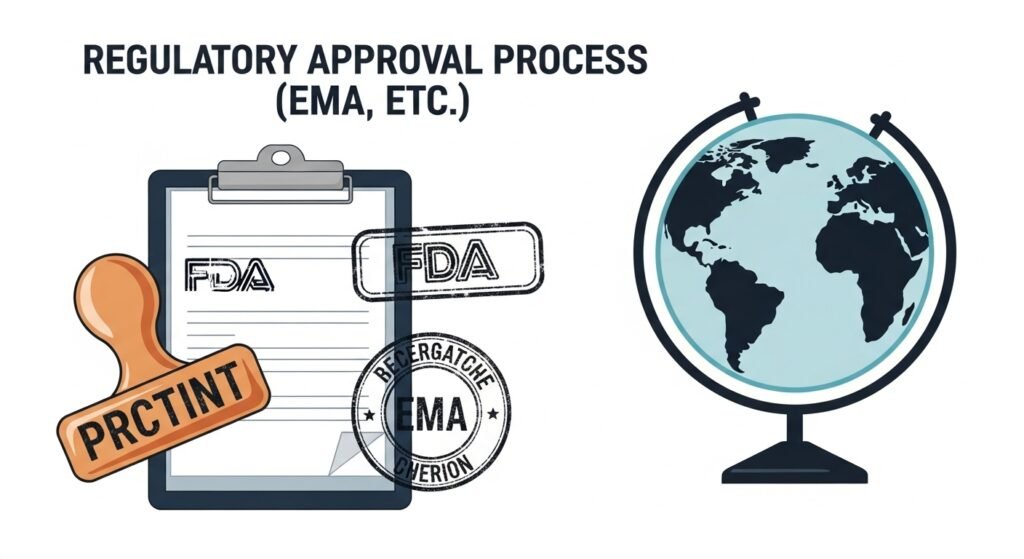
If Phase 3 is a success, the company compiles all the data (often thousands of pages long) and submits it to government regulatory bodies—like the FDA (Food and Drug Administration) in the US, the EMA in Europe, or the CDSCO in India. These agencies meticulously review the data before legally allowing the drug to be sold.
5. Manufacturing and Quality Control
Once approved, the drug moves into mass production. Pharmaceutical manufacturing happens in highly sterile, strictly controlled environments known as “cleanrooms.” Even a tiny fluctuation in temperature or humidity can ruin a batch of medicine, so precision is everything.
6. Marketing and Distribution
Finally, the drug is distributed globally. Companies educate doctors and healthcare providers about the new treatment so they can prescribe it to the patients who need it most.
Major Segments of the Pharmaceutical Market
To truly understand the pharma industry, it helps to know how the products are categorized:
- Prescription (Rx) Drugs: Medications that require a doctor’s authorization to purchase. These are usually for more severe or chronic conditions.
- Over-the-Counter (OTC) Drugs: Safe, consumer-friendly medicines you can buy right off the shelf, like basic pain relievers or cough syrups.
- Branded Drugs: Original, patented medications developed through expensive R&D. They hold exclusivity for a set number of years.
- Generic Drugs: Once a branded drug’s patent expires, other companies can make the exact same formula. Generics are just as safe and effective but cost significantly less.
- Biologics: The fastest-growing segment. Instead of being mixed from chemicals, these drugs are grown from living cells. They include vaccines, gene therapies, and treatments for complex diseases like cancer and autoimmune disorders.
How Big is the Pharmaceutical Market in 2026?
The financial footprint of the pharmaceutical industry is staggering.
- Global Market Size: As of 2025/2026, the global pharmaceutical market is valued at approximately $1.6 to $1.7 Trillion and is expected to surge past $2.5 Trillion by 2033.
- Top Growth Drivers: The massive demand for oncology (cancer) treatments, immunology drugs, and the recent explosion of GLP-1 weight-loss and diabetes medications (like Ozempic and Wegovy).
- The India Factor: India is famously known as the “Pharmacy of the World.” Valued at over $60 Billion, India is the largest provider of generic medicines globally, supplying affordable healthcare to over 200 countries.
The Biggest Challenges Facing the Industry
Despite its size and success, pharma is not an easy business. Companies constantly navigate major hurdles:
- The “Patent Cliff”: When a blockbuster drug loses its patent, generic competitors flood the market, causing the original creator to lose billions in revenue almost overnight.
- High Failure Rates: For every 10,000 compounds discovered, only about one makes it to the market. The financial risk of R&D is astronomical.
- Strict Regulations: Complying with constantly changing, incredibly strict global health regulations takes immense time and resources.
- Supply Chain Vulnerabilities: The industry relies heavily on global supply chains for Active Pharmaceutical Ingredients (APIs). As recent geopolitical tensions have shown, disruptions can lead to dangerous medicine shortages.
Future Trends: What’s Next for Pharma in 2026 and Beyond?
The pharmaceutical industry is currently undergoing a massive technological revolution. Here is what is actively shaping the future of medicine right now:
- Artificial Intelligence (AI) in Drug Discovery: AI and “Agentic AI” are drastically shortening the time it takes to discover new drugs. Algorithms can now predict how molecules will behave in seconds, a task that used to take human scientists years.
- Personalized and Precision Medicine: We are moving away from a “one-size-fits-all” approach. Thanks to genomics, doctors can now prescribe treatments uniquely tailored to an individual’s specific DNA profile.
- Advanced Gene and Cell Therapies: Technologies like CRISPR are allowing scientists to literally edit genes to fix mutations, offering potential cures for inherited diseases like sickle cell anemia, rather than just treating the symptoms.
- Decentralized Clinical Trials: Thanks to wearable tech (like smartwatches) and telehealth, patients can now participate in clinical trials from their living rooms, making research faster, cheaper, and more diverse.
- Continuous Manufacturing: Instead of making drugs in slow, step-by-step “batches,” the industry is moving toward non-stop, automated production lines that are faster, cheaper, and less prone to human error.
Conclusion
The pharmaceutical industry is the backbone of modern healthcare. While it is a massive, profit-driven business, it is also the reason humanity has eradicated certain diseases, extended global life expectancies, and turned once-fatal conditions into manageable illnesses.
As we look toward the future, the integration of artificial intelligence, biotechnology, and personalized medicine promises an era where treatments are faster to develop, safer to use, and uniquely tailored to you.
Frequently Asked Questions (FAQs)
1. What is the difference between pharma and biopharma? Traditional pharmaceuticals are chemically synthesized in a lab (like aspirin). Biopharmaceuticals are complex medicines manufactured in, extracted from, or semi-synthesized from biological sources (living cells).
2. Why do new medicines cost so much? The high cost of new drugs largely reflects the immense financial risk of R&D. It costs billions of dollars and takes over a decade to develop a drug, and companies factor in the costs of the thousands of failed drug attempts into the price of the one that succeeds.
3. Who regulates the pharmaceutical industry? It is regulated by government health authorities. The most prominent include the FDA (United States), the EMA (European Medicines Agency), and the CDSCO (India). The World Health Organization (WHO) also plays a massive role in setting global standards.
4. What is a “Blockbuster Drug”? In the pharma industry, a blockbuster drug is an extremely popular medication that generates more than $1 billion in annual sales for the company that created it.
5. How is AI changing the pharmaceutical industry? AI is revolutionizing the space by analyzing massive datasets to discover new drug targets faster, optimizing clinical trial patient matching, automating safety monitoring, and improving manufacturing efficiency.